How to Choose a B2B Platform for Wholesale — 2026 Comparison
Two Paths to a B2B Ordering System
If you run a wholesale distribution business and you are ready to move order intake online, you face a fundamental choice: subscribe to a SaaS platform or build a custom portal.
Both approaches get you a product catalog, client accounts, and order management. But they differ significantly in cost structure, flexibility, data ownership, and long-term economics.
This guide compares the two approaches based on criteria that matter to wholesale distributors — not theoretical features, but practical trade-offs that affect your bottom line.
SaaS Platforms: What You Get
SaaS (Software as a Service) B2B platforms are ready-made solutions you subscribe to. In the Polish wholesale market, the most common options include TrisoB2B, Automico, and generic platforms like Shopify Plus or BigCommerce B2B.
Advantages:
- Fast initial setup (days, not weeks)
- No upfront development cost
- Regular feature updates
- Vendor handles hosting and security
Limitations:
- Per-order or per-user transaction fees
- Limited customization — you work within the platform's framework
- No code ownership — if you leave, you start from scratch
- ERP integrations are often basic or require paid add-ons
- Branding options are constrained to templates
Custom B2B Portals: What You Get
A custom portal is built specifically for your business. It runs on your infrastructure (or managed hosting), you own the code, and it integrates directly with your ERP.
Advantages:
- Flat monthly cost, no per-order fees
- Full code ownership — you can switch vendors without losing the system
- Deep ERP integration tailored to your specific setup
- Complete branding control
- Custom workflows (approval chains, credit limits, delivery scheduling)
Limitations:
- Higher upfront investment (€3,500–€5,990)
- You need a reliable development partner
- Updates and new features require development work
The Decision Matrix
| Criterion | SaaS Platform | Custom Portal |
|---|---|---|
| Setup cost | €0–€500 | €3,500–€5,990 |
| Monthly cost (base) | €200–€800 | €60 |
| Per-order fees | €0.50–€2.00 | €0 |
| Monthly cost at 500 orders | €450–€1,800 | €60 |
| Monthly cost at 1,000 orders | €700–€2,800 | €60 |
| Deployment time | 3–7 days | 10–14 days |
| ERP integration depth | Basic (standard connectors) | Deep (custom API mapping) |
| Code ownership | No | Yes |
| Branding | Template-based | Fully custom |
| Exit cost | High (rebuild from scratch) | Low (you own everything) |
| Custom workflows | Limited | Unlimited |
Cost Comparison: The Numbers That Matter
The real difference shows up when you look at total cost of ownership over 12 and 24 months.
Scenario: 500 orders per month
| Period | SaaS (mid-range) | Custom Portal |
|---|---|---|
| Setup | €300 | €4,500 |
| Year 1 total | €300 + (€500 × 12) = €6,300 | €4,500 + (€60 × 12) = €5,220 |
| Year 2 total | €12,300 | €5,940 |
| Year 3 total | €18,300 | €6,660 |
At 500 orders per month, the custom portal is cheaper from month 8 onward. By year 3, you have saved over €11,000 — and you own the code.
Scenario: 200 orders per month
| Period | SaaS (mid-range) | Custom Portal |
|---|---|---|
| Setup | €300 | €4,500 |
| Year 1 total | €300 + (€300 × 12) = €3,900 | €4,500 + (€60 × 12) = €5,220 |
| Year 2 total | €7,500 | €5,940 |
At 200 orders per month, the SaaS platform is cheaper for the first 18 months. The break-even point comes around month 20.
The takeaway: If you process more than 300 orders per month, a custom B2B wholesale portal pays for itself within the first year. See a full cost breakdown in How Much Does a B2B Portal Cost? and our platform comparison page.
ERP Integration: The Hidden Differentiator
On paper, both SaaS platforms and custom portals offer ERP integration. In practice, the depth of integration varies enormously.
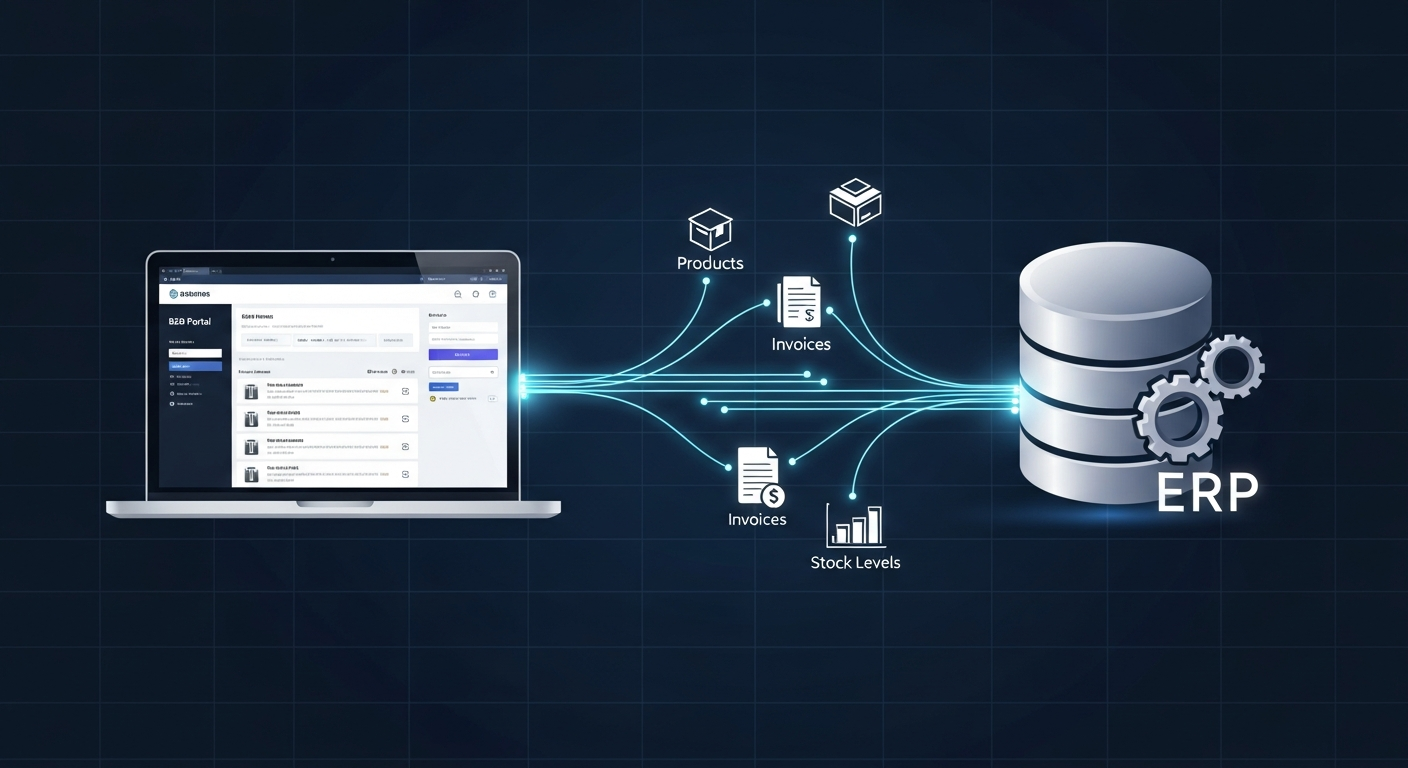
SaaS platforms typically offer pre-built connectors for popular ERPs. These connectors handle basic data: products, prices, stock levels, and orders. But they often struggle with Polish-specific ERPs (Subiekt GT, Optima, enova365) and edge cases like multi-warehouse stock, complex discount structures, or custom document workflows.
A custom portal integration is built specifically for your ERP instance. It handles your exact data model, your specific pricing rules, and your particular document flow.
When to Choose SaaS
Choose a SaaS platform when:
- You process fewer than 200 orders per month
- You need to go live this week, not in two weeks
- Your ERP is a major international system with standard connectors (SAP, Microsoft Dynamics)
- You want to test whether your clients will actually use an online ordering system before investing in a custom solution
- Your budget for year one is under €4,000
When to Choose Custom
Choose a custom portal when:
- You process 500+ orders per month (the economics are clear)
- You use a Polish ERP system that SaaS platforms do not support well
- You need custom workflows (approval chains, credit limits, delivery scheduling, minimum order values per product category)
- Code ownership matters to you — you do not want to be locked into a vendor
- You have specific compliance requirements (alcohol distribution, pharmaceutical, food safety)
- You plan to expand to multiple warehouses or countries
Let’s talk about your project
Free 30-minute consultation. We’ll figure out if and how I can help.